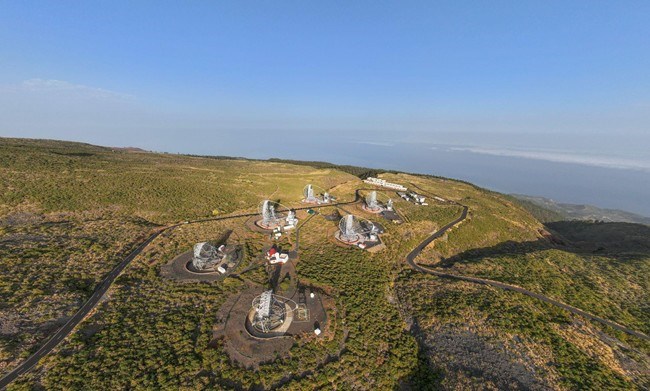
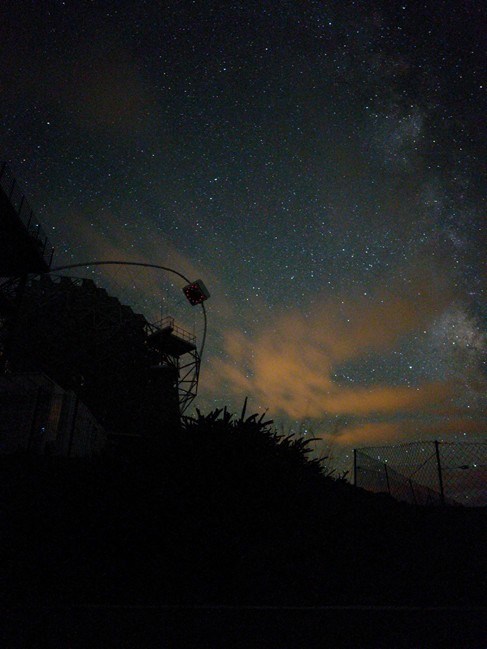
Two hundred and fifty scientists and representatives of research institutions from around the world gathered at the Roque de los Muchachos Observatory on La Palma to celebrate the inauguration of the four-telescope Large-Sized Telescope array. This marks a key step toward full scientific operation of the Cherenkov Telescope Array Observatory (CTAO), world’s largest and most powerful observatory for gamma-ray astronomy.
University of Split, FESB’s—contributing to development of LSTs
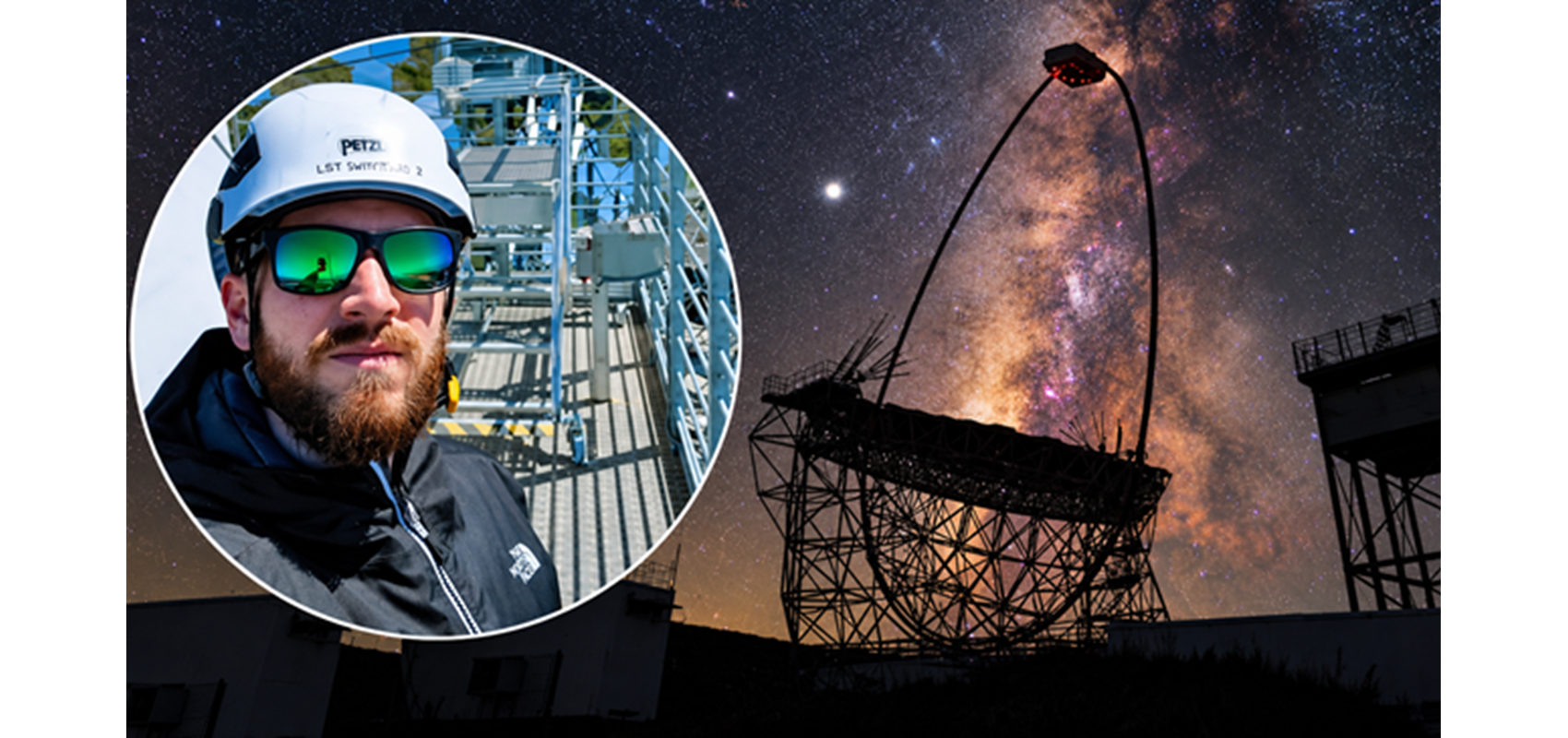
The research group at the Faculty of Electrical Engineering, Mechanical Engineering and Naval Architecture (FESB), University of Split, working in collaboration with the University of Padua, developed an independent optical system comprising two cameras positioned at reflector’s centre. The CDM camera measures the position of the Cherenkov camera, located 28 metres away, ten times per second, with an accuracy better than 5 arcseconds—equivalent to a displacement of just 0.7 millimetres. The StarGuider camera uses stars to relate that position to celestial coordinates. The CDM system has been operating successfully on the LST-1 telescope since 2018. Building on that experience, the Split team, led by prof. Nikola Godinović, PhD, developed an improved system for telescopes LST-2, LST-3, LST-4, and the equipment has already been procured. A key contribution came from doctoral researcher Toni Šarić, MSc in Physics, who developed numerous software tools for automated, real-time image processing and conducted extensive measurements at FESB and at the Mosor Zvjezdano selo observatory until the required accuracy was achieved. The team also tested the OARL reference laser, whose pointing remained stable within 5 arcseconds for more than 16 hours. Pointing corrections will be applied during data analysis, and their effect will be tested using observations of the Crab Nebula. “This shows that even a small research group with limited resources can make a valuable contribution to major international scientific projects through knowledge, expertise and dedication,” says prof. Nikola Godinović, PhD, from University of Split’s FESB.
Croatia—a full member of CTAO ERIC
In 2025, Croatia became a full member of the international organization CTAO ERIC, gaining the right to participate on an equal footing in managing one of world’s most ambitious astronomy projects. More importantly, through the participation of Croatian research institutions in CTAO, Croatian doctoral researchers and young scientists will have access to unique scientific data the observatory will collect over its three decades of operation.
Official CTAO-LST announcement
Photo: LST Collaboration